Have you ever stopped while writing and wondered, is it envelope or envelop? You are not alone. This is one of the most searched spelling questions in English. The two words look almost the same. They sound similar. But they do not mean the same thing.
Many people search for envelope or envelop meaning, Do you say envelope or envelop?, or Does an envelope have an e at the end? The confusion usually happens because only one small letter changes the word. That final “e” makes a big difference.
In this complete guide, you will get a quick answer, detailed explanation, pronunciation help, real-life examples, common mistakes, and usage advice. By the end, you will clearly understand the spelling of envelope or envelop and feel confident using both correctly in English.
Envelope or Envelop Means :
Here is the simple rule:
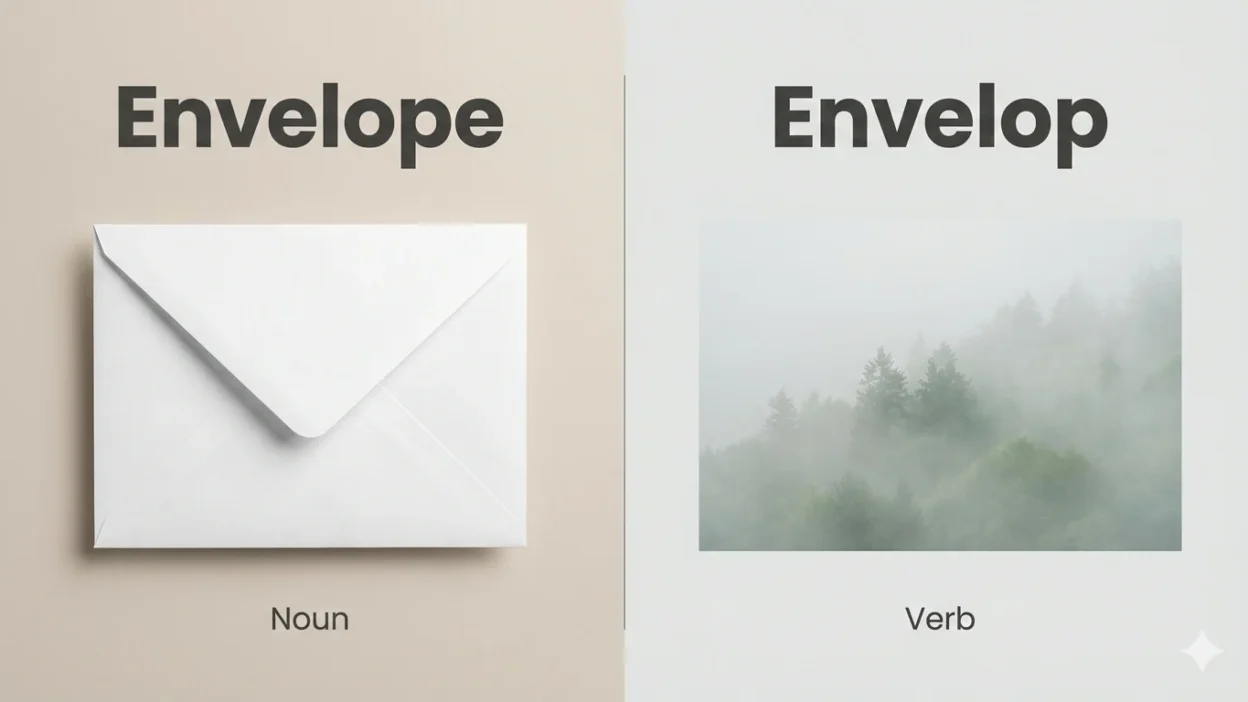
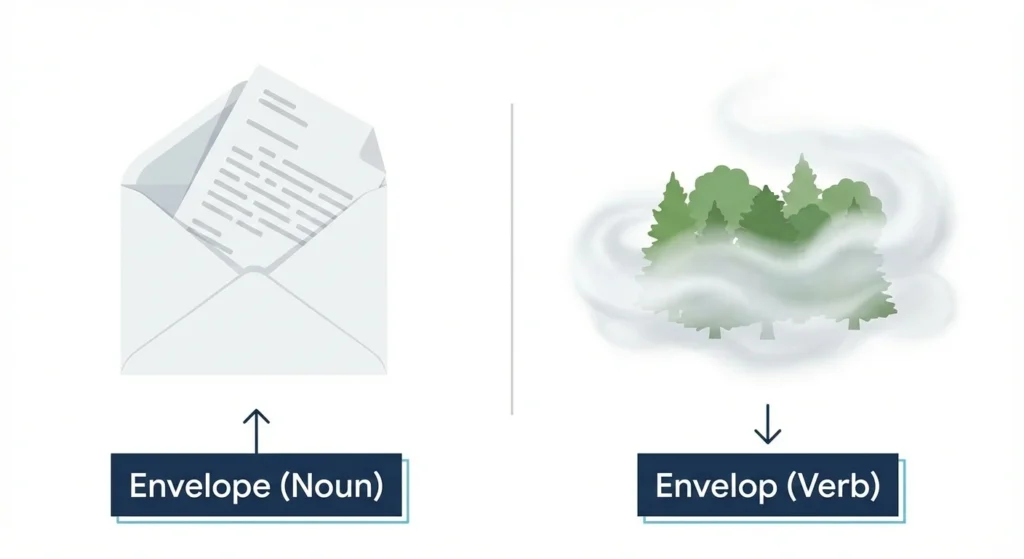
- Envelope (with “e” at the end) is a noun.
- Envelop (without “e”) is a verb.
✔ Envelope = A paper cover for letters
Example:
- I placed the invitation inside the envelope.
- She wrote the address on the white envelope.
So if you ask, Does an envelope have an e at the end? — yes, always.
✔ Envelop = To wrap or surround completely
Example:
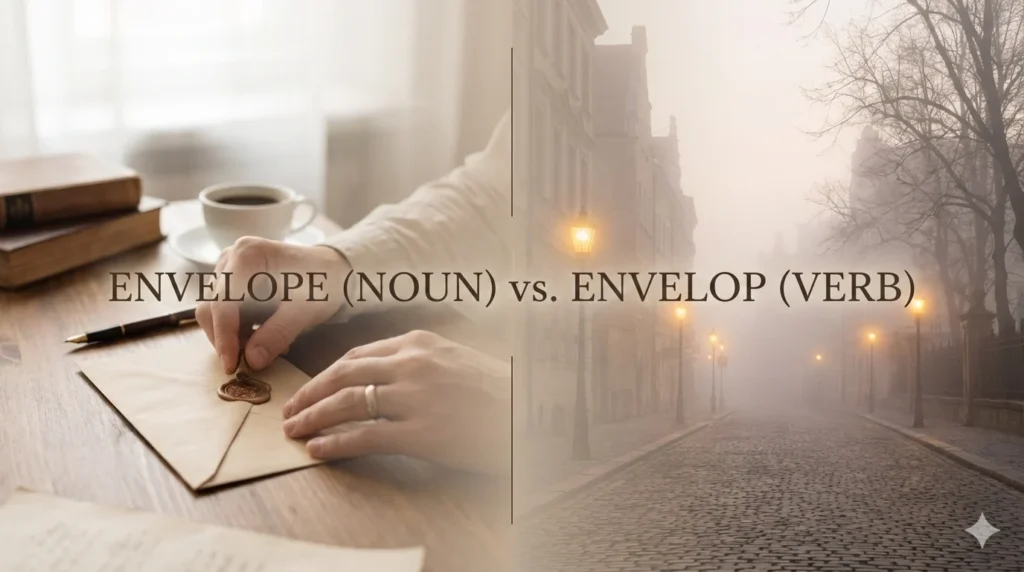
- Thick fog began to envelop the city.
- A strange silence envelops me at night.
- Darkness enveloped the forest.
If you are asking, Do you say envelope or envelop? — it depends on meaning.
If it is an object → envelope
If it is an action → envelop
This is the key difference in envelope or envelop in English.
The Origin of Envelope or Envelop
Both words come from French.
- Envelope comes from the French noun enveloppe, meaning “wrapper.”
- Envelop comes from the French verb envelopper, meaning “to wrap.”
In the 14th and 15th centuries, English borrowed these words. Over time, English kept both forms but gave them different roles.
The spelling of envelope or envelop stayed very close to the original French. That is why they look so similar today.
Here is how they developed:
| Word | French Root | Meaning | Part of Speech |
|---|---|---|---|
| Envelope | enveloppe | A wrapper | Noun |
| Envelop | envelopper | To wrap | Verb |
The extra “e” at the end of envelope helps show that it is a noun. The shorter word envelop became the verb form.
This explains the historical reason behind the envelope or envelop meaning difference.
British English vs American English Spelling
Many English words change spelling between the UK and the US (like colour vs color). But here is good news:
There is no spelling difference between British and American English for envelope or envelop.
Comparison Table
| Word | Part of Speech | US Spelling | UK Spelling | Example |
|---|---|---|---|---|
| Envelope | Noun | Envelope | Envelope | She mailed the envelope. |
| Envelop | Verb | Envelop | Envelop | Smoke enveloped the house. |
However, pronunciation may change slightly.
Envelope or envelope pronunciation
- American English: /ˈɛn.və.loʊp/
- British English: /ˈɒn.və.ləʊp/
The stress is on the first syllable: EN-velope.
Now let’s look at the verb pronunciation:
Envelop pronunciation
- /ɪnˈvɛləp/
Notice the stress moves:
- EN-velope (noun)
- en-VEL-op (verb)
This difference in stress also helps avoid confusion.
Which Spelling Should You Use?
If you are unsure which spelling to use, ask yourself:
Am I talking about a thing or an action?
Use Envelope when:
- Writing emails about documents
- Talking about mail
- Referring to packaging
- Writing formal business content
Example:
- Please return the signed form in the envelope.
- The company logo is printed on the envelope.
Use Envelop when:
- Writing stories
- Describing emotions
- Writing news reports
- Using poetic language
Example:
- A deep silence enveloped the crowd.
- Warm light envelops the room every morning.
- The blanket seemed to envelop someone in comfort.
If your audience is US, UK, Canada, Australia, or global — the rule is the same.
There is no regional spelling change.
Common Mistakes with Envelope or Envelop
Let’s fix the most common errors.
❌ Mistake 1: Using envelop for a letter cover
Wrong:
- I forgot the envelop.
Correct:
- I forgot the envelope.
❌ Mistake 2: Forgetting verb tense
Wrong:
- Smoke envelop the house.
Correct:
- Smoke enveloped the house.
Envelop Verb Forms
| Tense | Example |
|---|---|
| Present | Fog envelops the city. |
| Past | Fog enveloped the city. |
| Continuous | Fog is enveloping the city. |
Envelop Past Tense
The past tense of envelop is enveloped.
Example:
- Fear enveloped the village.
Envelop Plural
Many people search for envelop plural.
Important:
Envelop is a verb. Verbs do not have plural forms.
But you can say:
- He envelops
- She envelops
- It envelops
Envelop Synonym
If you need an envelop synonym, here are common ones:
- Surround
- Cover
- Wrap
- Enclose
- Shroud
If you search for envelope or envelop synonym, remember:
Envelope synonyms:
- Wrapper
- Cover
- Packet
Envelop synonyms:
- Surround
- Enclose
- Wrap
Envelope or Envelop in Everyday Examples
Let’s see envelope or envelop examples in daily life.
In Emails
- Kindly place the contract inside the envelope.
- A calm feeling envelops me when I read your message.
In News Writing
- Thick smoke enveloped the building.
- Police discovered a sealed envelope at the scene.
In Social Media Posts
- Happiness envelops me today.
- I need to buy an envelope for this letter.
In Formal Writing
- The award certificate arrived in a gold envelope.
- Darkness began to envelop the entire valley.
Envelop in a Sentence (More Examples)
- The mist will envelop the hills at sunset.
- A sense of peace envelops me during prayer.
- Cold air enveloped the travelers.
- Silence envelops the room after the speech.
To Envelop Someone
You can say:
- The blanket enveloped the child.
- Love can envelop someone completely.
- A wave of emotion enveloped her.
These examples clearly show the action meaning.
Envelope or Envelop – Google Trends & Usage Data
Search data shows that envelope is far more commonly searched than envelop.
Why?
Because:
- People use envelope in daily life.
- Students worry about exam spelling.
- English learners ask: Is it envelope or envelop?
- Many ask: Do you say envelope or envelop?
Search Intent Breakdown
- Spelling confusion
- Grammar check
- Pronunciation help
- Meaning clarification
Countries with high search volume:
- United States
- United Kingdom
- India
- Pakistan
- Canada
- Australia
Usage Frequency
Envelope appears more in:
- Business writing
- Postal services
- Office communication
- School exams
Envelop appears more in:
- Literature
- News articles
- Creative writing
- Emotional descriptions
This shows that envelope is practical and common. Envelop is descriptive and expressive.
Envelope or Envelop Meaning – Side-by-Side Comparison
| Feature | Envelope | Envelop |
|---|---|---|
| Type | Noun | Verb |
| Meaning | Paper cover | To wrap or surround |
| Example | The envelope is blue. | Fog enveloped the city. |
| Plural | Envelopes | No plural |
| Past Tense | N/A | Enveloped |
| Pronunciation Stress | First syllable | Second syllable |
| Usage Area | Mail, office | Literature, news |
FAQs
1. Do you say envelope or envelop?
You say envelope for a paper cover. You say envelop when you mean to surround something.
2. What does “envelop” mean?
Envelop means to wrap, surround, or cover completely.
3. Does an envelope have an e at the end?
Yes. Envelope always ends with the letter “e.”
4. Is envelope an English word?
Yes. Envelope is a standard English noun used worldwide.
5. What is envelop plural?
Envelop is a verb. It does not have a plural form.
6. How do you use envelop in a sentence?
Example: Thick fog enveloped the mountains.
7. What is envelope or envelop in English?
Envelope is a noun (object). Envelop is a verb (action).
Conclusion
The confusion between envelope or envelop is simple to solve once you understand the grammar. Envelope, with an “e” at the end, is a noun. It is the paper cover you use for letters and documents. Envelop, without the final “e,” is a verb. It means to wrap, surround, or cover something completely.
There is no difference between British and American spelling. The only difference is meaning and grammar role. Remember this easy trick: if you can hold it in your hand, it is an envelope. If it is happening as an action, it is envelop.
Now when someone asks, is it envelope or envelop? — you know the answer clearly. You can write, speak, and publish with confidence.

“Julian Rowe, a dream symbol researcher at DreamyDrug.com, explains spiritual messages, emotional visions, and subconscious patterns through clear, calming insights.”