

If you’ve ever woken up with a powerful dream—only to forget it by breakfast—you’re not alone. Dreams are fragile. They slip away within minutes unless captured with intention. That’s exactly why dream journal ideas are trending again in 2025—not as a simple hobby, but as a powerful tool for self-growth, emotional clarity, creativity, and spiritual alignment.
Today, dream journaling is more relevant than ever. With rising global stress, digital overwhelm, and increased interest in manifestation, shadow work, and self-discovery, people are turning back to this ancient practice to understand the messages their subconscious mind is trying to send.
This comprehensive guide will give you everything you need—creative dream journal ideas, practical steps, expert insights, examples, and modern-day tools—to build a journaling practice that actually works.
What Is a Dream Journal?
A dream journal is a personal diary where you record your dreams as soon as you wake up. It helps you capture details, emotions, symbols, and patterns that naturally fade within minutes.
In 2025, dream journals have expanded beyond simple notebooks. They now include digital apps, guided templates, reflection prompts, and hybrid methods that blend psychology with spirituality.
Why Dream Journaling Matters in 2025
Keeping a dream journal is more than curiosity—it’s transformational. Here’s why it’s gaining huge popularity:
1. Improves Dream Recall
Writing regularly trains your brain to remember dreams more clearly and vividly.
2. Enhances Emotional Awareness
Dreams often express emotions we ignore while awake.
3. Helps Reduce Stress & Anxiety
Understanding dream themes helps you process fears and anxieties safely.
4. Supports Manifestation & Visualization
Dream journaling aligns your intention with your subconscious mind—crucial for manifestation in 2025’s mindset trend.
5. Boosts Creativity
Many artists, writers, musicians, and innovators use dreams as inspiration.
6. Encourages Spiritual Growth
Dreams carry symbolism, archetypes, messages, and intuitive insights.
7. Tracks Personal Progress
You can observe emotional cycles, growth, repeating symbols, and breakthroughs.
Dream Journal Ideas for Beginners (and Beyond)
Below are the most powerful, practical, and creative dream journal ideas you can start using today—no matter your experience level.
1. The Classic “Write-Everything-You-Remember” Method
As soon as you wake up, jot down:
- People you saw
- Places
- Emotions
- Colors
- Actions
- Strange symbols
- Sounds or words
This raw capture preserves details before your conscious mind interferes.
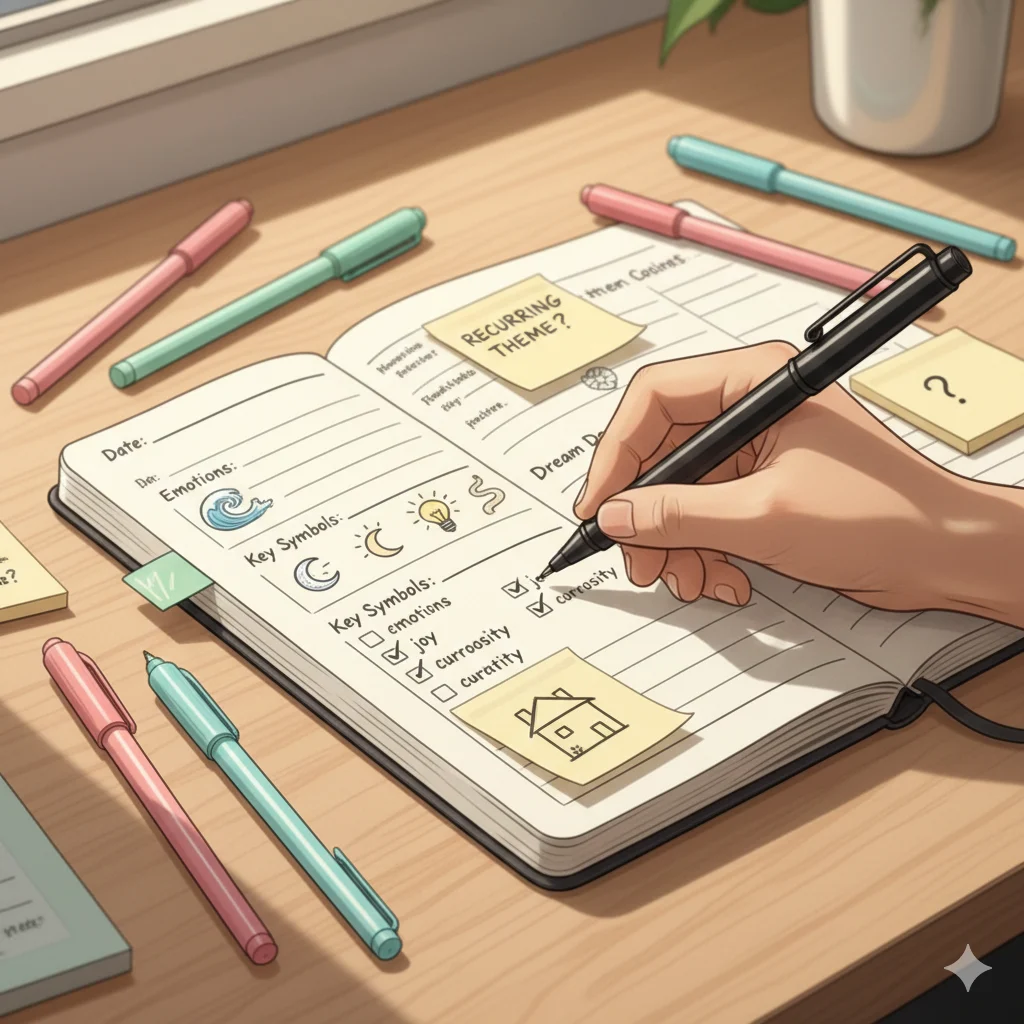
2. Emotion-Focused Dream Journaling
Instead of writing the entire dream, focus on emotions:
- What did you feel?
- Where did the emotion come from?
- Did it reflect something in real life?
This method is powerful for emotional healing and trauma processing.
3. Symbol & Meaning Journal
Perfect for those interested in dream symbolism.
Record:
- Main symbols
- Colors
- Animals
- Objects
- Locations
- Weather
- Feelings attached
Then write possible meanings and interpretations.
4. Dream Dialogue Technique
Imagine talking to a dream character or symbol and record the conversation.
This increases self-awareness and helps decode dream messages effectively.
5. Lucid Dream Tracking
If you practice lucid dreaming, keep notes on:
- Triggers
- What worked
- Dream clarity
- Control level
- Techniques used
This is extremely helpful for dream explorers.
6. Manifestation Dream Journal
Write dreams that relate to:
- Things you want
- Goals
- Positive signs
- Synchronicities
This merges dream journaling with manifestation practices.
7. Shadow Work Dream Journal
Your subconscious reveals hidden fears, blocks, and desires.
Record dreams that feel:
- Confusing
- Scary
- Intense
- Symbolically heavy
Then reflect on what part of your shadow they reveal.
8. “Dream Theme Tracker”
Create a list of repeating dream themes such as:
- Flying
- Falling
- Running
- Losing teeth
- Meeting strangers
- Being late
- Water dreams
Tracking themes helps you uncover long-term emotional patterns.
9. Creative Dream Journaling
Turn dreams into:
- Poems
- Sketches
- Story ideas
- Song concepts
- Visual art
Many famous creators (e.g., Salvador Dalí, Paul McCartney) used dreams as creative fuel.
10. Spiritual Dream Journal
Record dreams that feel:
- Mystical
- Intuitive
- Guiding
- Symbolic
- Connected to ancestors, angels, or spiritual signs
Include interpretations and gut feelings.
11. “Dream to Reality” Journal
Write how each dream connects to real life:
- Did it reflect something that happened yesterday?
- Did it reveal something you’re avoiding?
- Did it predict a future event?
This helps decode subconscious wisdom.
12. Nighttime Intention Log
Write what you want to dream about before sleeping:
- A question
- A person
- A problem
- A memory
- A goal
Then record how your dream responded.
This is extremely helpful for clarity and decision-making.
How to Start a Dream Journal: Step-by-Step Guide
Whether you prefer traditional writing or a digital app, the steps below will help you build a consistent dream journaling habit.
Step 1: Choose Your Format
You can use:
- A notebook
- A dream journal template
- A digital app
- A voice recorder
- A hybrid system
Pick whatever feels natural.
Step 2: Keep It Close to Your Bed
The faster you write, the more details you can save.

Step 3: Write Immediately After Waking
Even 30–60 seconds of delay can erase important details.
Step 4: Record Feelings First
Even if the dream is blurry, feelings remain strong.
Step 5: Add Details Slowly
Don’t pressure yourself. Let details flow naturally.
Step 6: Review Weekly
Look for:
- Patterns
- Recurring symbols
- Emotional cycles
- Messages
- Intuitive hints
Step 7: Use Prompts When Stuck
Try writing:
- “The first thing I remember is…”
- “The dream felt like…”
- “This dream reminds me of…”
Prompts break mental blocks.
Examples of Dream Journal Entries
Here are three realistic dream journal examples to help you understand how detailed—or simple—your entries can be.
Example 1: Emotional Dream
“I was standing in an empty room with light coming through the window. I felt peaceful. My grandmother’s voice told me everything would be okay.”
Interpretation:
A dream of reassurance and healing.
Example 2: Stress Dream
“I was late to class again. Running. Lost. Heart racing.”
Interpretation:
Reflects real-life stress or fear of failure.
Example 3: Spiritual Dream
“I was walking through water filled with glowing fish. A calm voice said, ‘Trust your path.’”
Interpretation:
Symbol of intuition, clarity, and emotional cleansing.
Dream Journal Mistakes to Avoid
Even with enthusiasm, beginners often make common errors. Avoid these for a smoother journey:
- Writing too long (overwhelms you)
- Waiting too long after waking
- Over-interpreting every detail
- Ignoring recurring symbols
- Not tracking emotions
- journaling inconsistently
- Using vague descriptions (“It was weird”)
Modern Dream Journaling Trends in 2025
Dream journaling has evolved significantly. Here’s what’s popular now:

1. AI-Assisted Dream Interpretation Apps
Apps help organize patterns, identify symbols, and offer insights.
2. Digital Voice-to-Text Dream Journals
You record your dream half-asleep—AI turns it into text.
3. Smart Sleep Trackers
Track sleep phases to improve dream recall.
4. Guided Dream Prompts Based on Astrology
Many use zodiac insight to interpret emotional dream patterns.
5. Hybrid Journaling (Digital + Paper)
A trend where you sketch on paper but store details digitally.
Cultural & Historical Background
Dream journaling isn’t new. It’s centuries old.
- Ancient Egyptians believed dreams were messages from gods.
- Greek philosophers like Aristotle studied dreams for self-knowledge.
- Chinese traditions viewed dreams as spiritual journeys.
- Native cultures used dreams for healing and intuition.
Today, dream journals blend ancient wisdom with modern psychology for deeper insight.
Expert Tips for Better Dream Journaling
These techniques can dramatically boost your dream recall and clarity:
- Drink water before bed (helps memory).
- Sleep earlier for stronger REM cycles.
- Reduce screens before bed.
- Use a gentle alarm.
- Write dreams even if incomplete.
- Give titles to each entry.
- Review dreams before sleeping to improve recall.
FAQs About Dream Journal Ideas
1. What should I write in a dream journal?
Anything you remember—people, symbols, actions, emotions, colors, or even fragments.
2. Can dream journaling improve mental health?
Yes. It helps with stress relief, emotional processing, and self-awareness.
3. How often should I write in my dream journal?
Daily is ideal, but 3–4 times a week is still effective.
4. What if I don’t remember my dreams?
Write your feelings upon waking. Dream recall improves over time.
5. Are dream symbols universal?
Some are common, but many depend on personal experiences.
Conclusion
Dream journal ideas aren’t just about writing—they’re about connecting with your inner world. In 2025, dream journaling is one of the most valuable tools for emotional healing, creativity, spiritual growth, and personal transformation. If you commit to this practice, you’ll uncover the wisdom your subconscious has been trying to tell you all along.
Start tonight.
Write one line.
Your dreams are waiting to speak to you.

“Evelyn Hartwell, a spiritual dream guide at DreamyDrug.com, interprets symbolic dreams and emotional patterns to help readers understand their inner world.”